


Organize a comparative guide around clearly defined criteria and separate records for each option being examined. Keep evidence, uncertainty, and editorial conclusions distinguishable. This lets you revise one entry or add another option without silently changing the meaning of the comparison or forcing every case into an unsupported ranking.
Define the reader's decision
State what the reader is choosing between and which constraints shape that choice. A guide comparing methods for a beginner has different priorities from one comparing approaches for an experienced practitioner. The manuscript should make its decision context explicit before presenting a table of advantages and disadvantages.
Record the scope of the comparison. Explain which kinds of options are included and which are outside the book's purpose. A selection of representative approaches should not appear to be an exhaustive survey unless the research and manuscript support that claim.
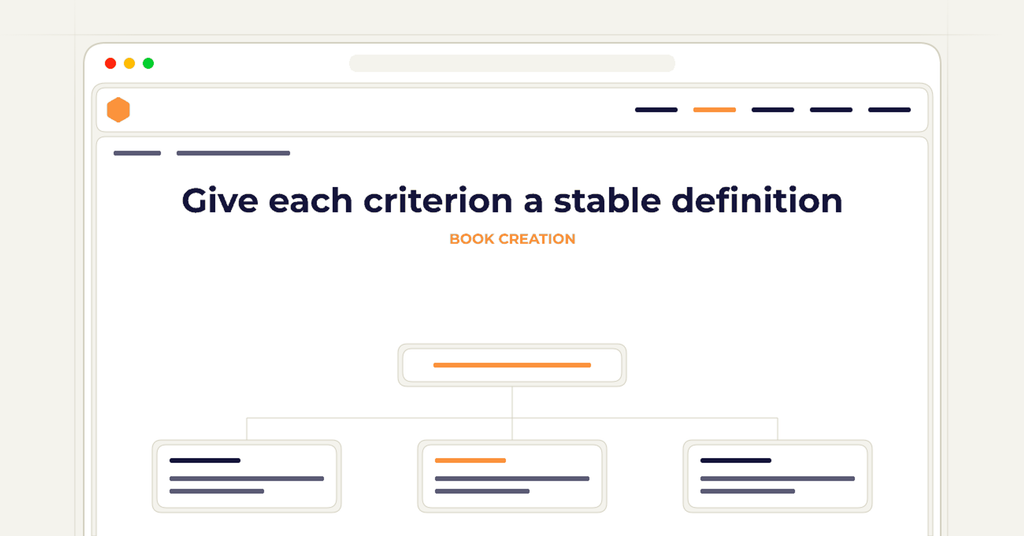
Give each criterion a stable definition
Create a criterion record with its meaning, the evidence needed to assess it, and any limits. Terms such as simple, flexible, or efficient can mean different things to different readers. Define the relevant task or condition instead of relying on an appealing but ambiguous label. For example, separate the time needed to prepare a method from the time needed to repeat it. Combining those into one vague convenience score can hide the tradeoff a reader actually needs to understand.
Keep criteria independent where possible. If several headings describe essentially the same benefit, the comparison may give that benefit disproportionate emphasis. Review the structure for overlap before using it to organize every entry in the book.
Store evidence separately from conclusions
For each option, record observations and sources under the relevant criteria. Mark information that is missing, uncertain, or dependent on specific conditions. A blank evidence field should not quietly become a negative judgment about the option.
Write the editorial conclusion in a separate field that explains how the evidence relates to the reader's decision. This makes it easier to review whether the conclusion is supported and to update it when the evidence changes. It also prevents a fluent summary from replacing the underlying research record.
Preserve differences that matter
Some options may not fit every criterion in the same way. Explain genuine differences rather than forcing an artificial equivalence merely to fill a uniform table. A criterion may be inapplicable to one case, which is different from that case performing poorly.
Use prose where a compact table would hide important qualifications. The manuscript can combine consistent entry records with more detailed explanations of difficult comparisons. Consistency should help readers navigate the evidence, not erase the conditions that make the comparison meaningful.

Make priorities explicit without inventing universal rankings
If the guide weights criteria or names a preferred option, explain the reader situation behind that choice. An approach favored for one constraint may be less suitable under another. Keep the recommendation connected to the stated assumptions rather than presenting it as a universal result.
Review any numerical score for what it actually represents. A precise-looking total can conceal subjective judgments or incomplete evidence. Do not let arithmetic give an impression of certainty that the underlying records cannot support.
Revise entries and comparisons together
When an option changes or new evidence arrives, update its record and review the affected tables, summaries, and conclusions. Adding a new option may reveal a missing criterion or change the context of an earlier comparison. Treat that as an editorial review rather than simply appending another row.
Before export, check terminology and references across the full guide. Confirm that the introduction, entry structure, and final recommendations use the same definitions and scope. Preserve the editable records so later editions can revise the reasoning transparently instead of rebuilding it from a static table in the published book.
Frequently asked questions
Clear answers for this publishing decision.
Should every comparison end with one winner?
No. Some guides are more useful when they explain which option fits which situation. Choose a conclusion structure that matches the reader's decision and the evidence.
Can an empty field be scored as zero?
Do not confuse missing evidence with poor performance. Record the uncertainty explicitly and decide how it affects the comparison before calculating or presenting a score.
What if one option needs a different kind of explanation?
Keep the shared criteria where they are meaningful and add clear context where necessary. A consistent manuscript structure can still accommodate genuine differences.
Can AI fill the comparison records?
It can help draft or organize supplied material, but verify the evidence, definitions, and conclusions. Do not accept invented details merely because they complete an otherwise uneven table.
How do I get from an idea and a brief to an editable manuscript I can finish?
Write the brief first, generate a structure you can edit, then draft and revise the manuscript in reviewable sections so one change never overwrites work you already approved.
Start a book project from a brief