


Before expanding a series around a shared template, complete a representative title and record which tasks the template simplifies, which require individual judgment, and which create repeated corrections. Estimate the remaining work from those observations. A reusable layout can reduce setup without reducing research, editing, or the review each book needs.
Choose a pilot that represents the planned books
A production template is most useful when it handles the features the series will actually contain. If the planned books include tables, illustrations, exercises, and several heading levels, a short text-only pilot will test too little. Select a representative title or a substantial sample containing the difficult recurring elements. Identify any features that remain untested before using the pilot to plan the rest of the series.
Write down what you expect to reuse. This might include paragraph styles, front matter structure, illustration placement conventions, or an export checklist. Keep reusable production decisions separate from content that must be written for each title. A template can reserve a place for a worked example, but it cannot establish that the next book’s example is accurate, relevant, or explained at the right level.
Record the work the template actually removes
During the pilot, keep a simple task record. Distinguish initial setup, ordinary use, corrections, and final review. A layout that takes time to configure may still make later work easier, while a quick setup can create recurring manual repairs. Record the cause of a correction as well as its duration so you can tell whether it belongs to the template or to that particular manuscript.
For example, a reusable exercise layout may work well for short prompts but require manual changes whenever a prompt spans two pages. If longer exercises are common in the planned series, those repairs belong in the future workload estimate. Do not describe them as a one-time exception merely because they first appeared in the pilot. The relevant question is whether the same condition is likely to recur.
Test variation instead of cloning the easiest chapter
Take the template through several realistic variations. Include a chapter with a long heading, a wide table, an illustration with a substantial caption, or whatever the series genuinely needs. Check whether the structure remains editable after content is inserted and revised. A template that looks attractive with demonstration text may behave differently when the author replaces that text with uneven real material.
Avoid forcing every book into the same length or chapter pattern just to preserve a convenient layout. The shared system should support each title’s reader task. When a variation needs a different structure, decide whether to add a controlled alternative to the template or treat that title separately. Record the choice so future books do not accumulate unexplained local fixes that make maintenance harder.
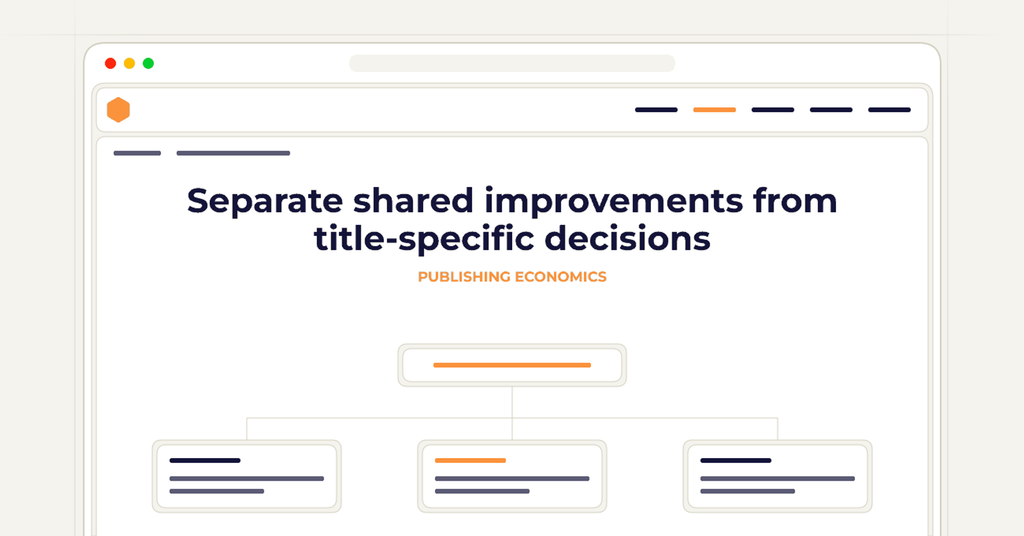
Separate shared improvements from title-specific decisions
When a pilot reveals a structural problem, repair the shared template before copying it into additional books. Check the repair against the other sample variations. A change that improves one table can alter spacing around every illustration. Preserve the prior version until the revised template has been reviewed so you can compare the effects and recover a useful design decision if necessary.
Keep content decisions with the title that owns them. A research claim, permission record, or answer explanation should not become accepted across the series simply because it appears in a reusable file. Mark demonstration content clearly in working templates and remove it from publication exports. Each book still needs its own content review and format-specific checks under the relevant current KDP guidance.
Expand according to the measured remaining work
Use the pilot record to describe the next group of titles. Identify reusable setup, recurring production tasks, and known exceptions. Include the time needed to review the assembled books and resolve individual issues. If the template changes substantially after the first title, update the estimate rather than carrying forward an outdated assumption about how quickly the remaining books can be completed.
A sensible expansion decision may be to prepare a small next group before committing the whole series. That gives you evidence about whether the template works beyond the original pilot. Keep the release plan flexible enough to repair shared problems before they spread. The practical benefit of a template is repeatable production with visible exceptions, not a reason to treat every book as finished when its text has been placed into familiar pages.
Frequently asked questions
Clear answers for this publishing decision.
Should the pilot be the shortest book in the series?
Choose it for representativeness rather than length alone. A short book can be a useful pilot if it includes the important production features. If it omits the elements likely to cause difficulty, document that limitation before estimating the remaining work.
Can I count all template setup as a future saving?
Record the setup separately and identify the tasks it actually removes from later titles. Some work remains necessary each time, and maintenance may add new tasks. Base the plan on observed reuse rather than treating the existence of a template as proof of lower total effort.
What if one title does not fit the shared structure?
Review whether the structure or the title should change for the reader’s benefit. A controlled alternative may be appropriate. Do not remove useful content or add filler solely to make the book conform to a production pattern.
What does this book cost to print and produce, and what should the list price be?
Printing cost follows from the trim, ink, and page count, the list price sets the royalty after that cost, and the production budget should be estimated before generation starts, so compare these numbers before you commit to a format or a plan.
See what a book project costs in credits