
On any given week, a single independent author can quietly release a polished trilogy, a workbook series and an updated nonfiction guide, all without a traditional publisher or a full time staff. The engine behind that output is increasingly a mix of disciplined process and artificial intelligence, and Amazon KDP has become the proving ground for what a modern one person publishing operation can look like.
The AI shift in self-publishing on KDP
Artificial intelligence is no longer a fringe experiment for self publishers. It now sits inside brainstorming tools, research dashboards, layout systems and cover studios. Some platforms market themselves as an ai kdp studio, promising an end to end environment for book production that feeds directly into Kindle Direct Publishing. Others focus on specialized tasks such as outlining, cover generation or ad copy.
That shift has created a new divide. On one side are authors who use AI to accelerate the parts of publishing they already understand. On the other side are those who hope an automated kdp book generator will produce a complete title with minimal oversight. The gap between those groups shows up clearly in reader reviews, in Amazon policy enforcement and in the long term viability of each author business.
Dr. Caroline Bennett, Publishing Strategist: The authors who win with AI are the ones who treat it as a force multiplier, not a replacement for judgment. They still understand structure, genre expectations, audience and positioning. AI makes them faster, not lazier, and that difference is obvious on every KDP product page.
Amazon has responded with updated disclosure requirements for AI assisted and AI generated content, and enhanced content review systems. For serious publishers, that makes one thing clear. You need an intentional ai publishing workflow that bakes quality control and kdp compliance into every stage, from idea to ad campaign.
Designing an AI publishing workflow that still puts craft first
A workflow is simply the sequence of steps you follow every time you create a book. AI does not remove those steps, it just changes who or what performs each piece. A robust workflow for KDP typically includes research, outlining, drafting, editing, formatting, cover and branding, metadata and positioning, launch and optimization.
In an AI intensive setup, each of those stages may plug into a different ai writing tool or specialized self-publishing software. A drafting assistant might help you expand chapter summaries. A summarizer might condense long interviews. A layout service might generate ready to upload interior files. The risk is fragmentation if you adopt tools ad hoc without mapping how they connect.
A practical approach is to draw a simple flowchart from idea to first royalty payment. For each step, decide whether it is human led with AI assistance, AI led with human review, or fully manual. Label the tools you plan to use, including any in house systems such as the AI powered tool available on this site, and document time estimates. That map becomes your repeatable blueprint rather than a new experiment for every book.
James Thornton, Amazon KDP Consultant: When I audit author businesses, the strongest ones can actually show me their workflow as a diagram or checklist. AI tools are attached to steps in that diagram. They are not random browser tabs. That one habit makes their output more predictable, easier to scale and far easier to outsource.
With a clear map, you can then evaluate where AI meaningfully reduces friction and where it introduces new risks, especially around originality, accuracy and policy alignment.
Market research, keywords and categories in an AI era
Most successful KDP launches begin with research rather than writing. Here AI is particularly strong as a pattern detector and assistant, provided you direct it with good questions and verify the outputs.
For keyword discovery, dedicated tools can handle kdp keywords research by ingesting Amazon autocomplete terms, competitor titles and historical sales signals. Some suites position themselves as a niche research tool, surfacing underserved subtopics or reader pain points. Others function as a kdp categories finder, suggesting the most appropriate and least competitive category and subcategory combinations for maximum visibility.
AI can help here in two ways. First, it can cluster related search terms into themes and suggest which ones belong on your product page, in your subtitle or in your backend keyword slots. Second, it can read through top ranking product descriptions and reviews to identify recurring language that signals reader intent. You can then mirror that language organically when you position your own book.
What AI cannot safely do on its own is guarantee accuracy of search volume or competition. For that, you still need data either from Amazon itself or from third party tools that clearly document their methodology. When you combine human judgment, verified numbers and AI summarization, your research layer becomes a durable asset instead of a guess.

It is also wise to document your research in a reusable format. Many professional publishers maintain a living spreadsheet of target keywords, their relevance scores, competing titles and notes on positioning. Over time that list becomes the raw material for future series ideas, spin off products and ad campaigns.
Writing, drafting and editing with AI assistance
On the creative side, AI tools can be used to outline, brainstorm, draft and even mimic specific voices. The label amazon kdp ai is sometimes applied broadly to any AI service that integrates with Kindle Direct Publishing, but in reality you are usually working with general purpose language models tuned or prompted for publishing tasks.
The most sustainable pattern is to keep humans in charge of structure and voice. Use an ai writing tool to expand bullet point outlines into rough paragraphs, to propose section transitions or to generate alternative openings and conclusions. Maintain a clear distinction between AI suggestions and your final prose. Many serious authors write the first draft themselves and then use AI for developmental comments or line level tightening.
Automation can also help with consistency checks. You can ask an assistant to scan the manuscript for continuity errors in character details, for timeline mismatches or for factual claims that need citations. While you must still verify each change, AI can triage the work so your human editor is focused on the highest value issues.
Laura Mitchell, Self-Publishing Coach: I tell clients to imagine AI as a room full of very fast but inexperienced interns. They can suggest a hundred ways to phrase a sentence, they can flag typos and contradictions, they can even draft scenes. But you are still the editor in chief. Your taste and your ethics decide what reaches readers.
Finally, consider documenting AI usage inside your book. A brief note in the copyright or acknowledgments section that explains where AI assisted the process can build trust, especially in nonfiction where accuracy matters. Transparency can also help if Amazon updates its disclosure expectations again in the future.
From manuscript to finished files formatting and layout
Once your text is stable, you move into the production phase. Here automation has existed for years, but AI is starting to improve options for complex layouts and multi format publishing.
Many tools now offer guided kdp manuscript formatting, handling front matter, headings, page breaks and visual hierarchy for you. Some integrate directly with style templates that align with genre norms, such as romance paperbacks, business hardcovers or illustrated workbooks. AI can assist by detecting chapter boundaries, inserting consistent scene breaks and ensuring that headings map correctly to a generated table of contents.
Two major outputs need attention. First, your ebook layout, which must render cleanly across Kindle devices and apps. Second, your print interior, which must match your chosen paperback trim size and pass KDP print checks. Automation can suggest appropriate margins, font sizes and line spacing for your trim, but it remains essential to inspect a proof carefully, preferably both on screen and in print.
To keep things consistent across a catalog, advanced publishers maintain interior templates. For example, you might have a standard nonfiction layout with specific heading fonts, callout box styles and figure captions. That template can be loaded into formatting software or described explicitly to AI tools so they respect your brand.

For teams, this stage is also where handoffs matter. Your editor, formatter and proofreader should work from a shared checklist so that no step is skipped when deadlines are tight.
Covers, branding and A+ content in a visual marketplace
Readers still judge books by their covers, especially when scrolling quickly through search results. AI has dramatically expanded the options for authors who cannot afford a full custom photoshoot or illustration, but it has also introduced new pitfalls around originality and rights.
An ai book cover maker can generate dozens of concepts in minutes based on prompts about genre, mood and visual motifs. Used wisely, that speed lets you explore a much broader range of ideas before settling on a final direction. The safest practice is to treat AI covers as concept art that a professional designer then refines using licensed assets and manual adjustments, reducing the risk of unintended resemblance to existing works.
Branding does not stop at the main cover. On Amazon, your A plus modules beneath the description can become a powerful selling asset if you treat a+ content design as part of your core creative work, not as an afterthought. Well constructed modules can show series reading order, highlight endorsements, visualize frameworks from your nonfiction, or offer a peek inside character relationships for fiction.
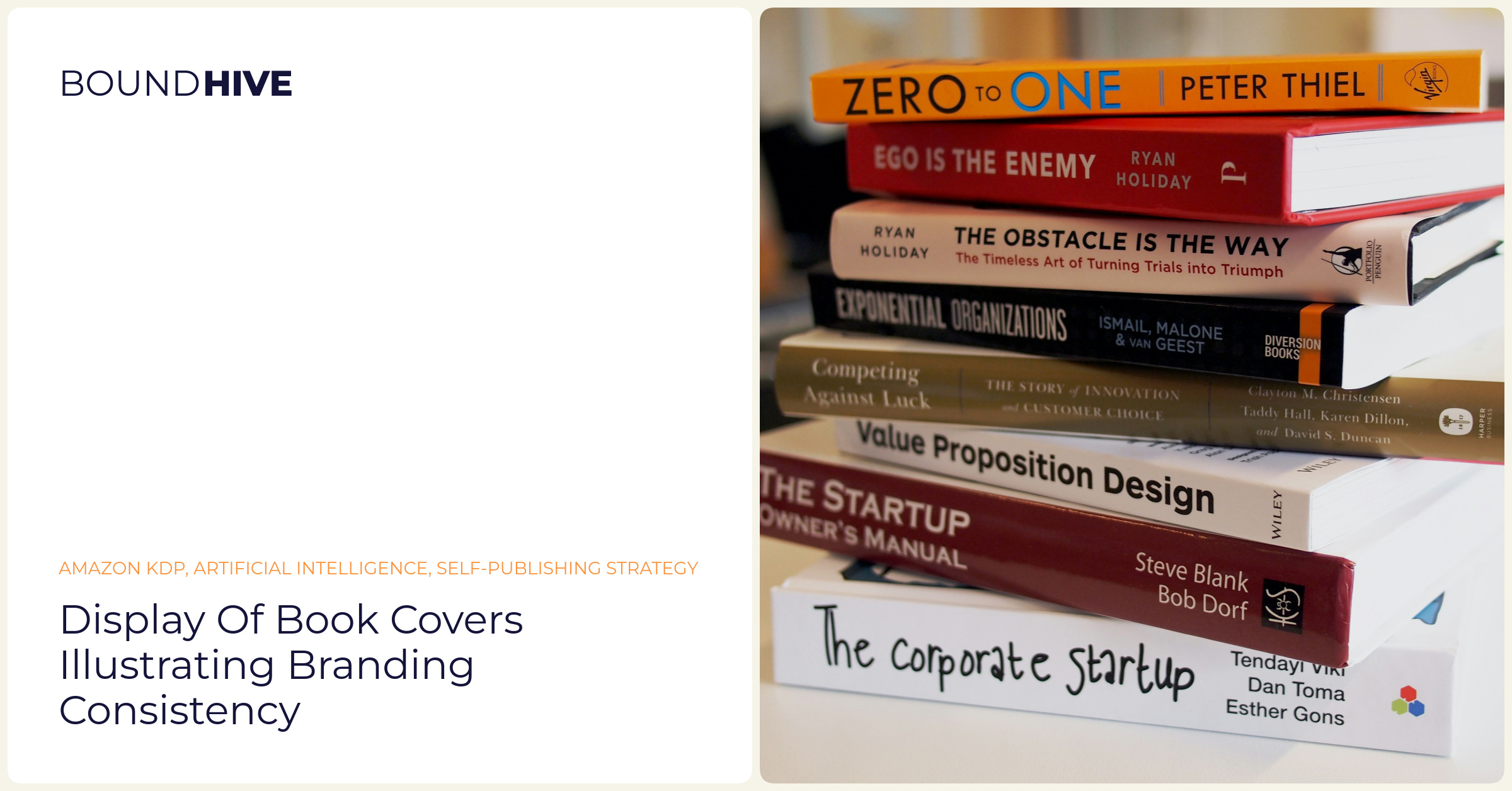
AI can help here as well by suggesting module layouts, generating background textures, or drafting copy variations for your feature blocks. The test of quality remains the same. Would a new reader, unfamiliar with you, immediately understand what the book offers and why it is different from adjacent titles in the same category.
Metadata, KDP SEO and conversion focused listings
Even the strongest manuscript and most compelling cover will underperform if the product page is weak. This is where metadata, positioning and on platform search visibility intersect.
Some AI driven services act as a book metadata generator, asking for your topic, audience and comparable titles, then proposing titles, subtitles, descriptions and keyword sets. Others bill themselves as a kdp listing optimizer, analyzing your existing page and suggesting changes that may improve click through and conversion rates.
At the core of these systems is the practice often called kdp seo. You are attempting to align what you say about your book with the phrases readers actually type into Amazon, while still sounding natural and persuasive. If you feed your research from earlier into an AI assistant, it can help you weave key phrases into a narrative description, test multiple hooks or craft benefit driven bullet points.
Here again, judgment matters. Over optimized copy that reads like a keyword dump will repel readers and may trigger Amazon scrutiny. Strong copy, by contrast, reads like a well argued book jacket that happens to echo reader search language in a natural way.
Outside of Amazon, your own website and blog can also play a role. Structured internal linking for seo can reinforce the authority of pillar pages about your main topics, which in turn can drive consistent organic traffic to your book landing pages, your newsletter sign up and your media kits. While this off Amazon strategy does not directly change KDP rankings, it strengthens the ecosystem that supports your author brand.
A sample high performance listing structure
To make this concrete, consider the skeleton of an example product listing for a data driven nonfiction title:
- A clear, benefit focused title and subtitle that incorporates one or two primary search phrases
- A description that opens with a hook, then uses short paragraphs and occasional bolding for skimmability
- Three to five bullet points emphasizing outcomes, proof and who the book is for
- Consistent branding between cover, A plus modules and author photo
- Back end keywords that target adjacent topics and long tail questions not used verbatim in the visible copy
An AI assistant can help you generate several variations of each element. You then select, combine and refine them, testing over time as reviews and ad data accumulate.
Advertising, analytics and iteration loops
Advertising on Amazon is no longer optional for many categories. Organic visibility is crowded, and Amazon Ads now sits at the center of numerous launch playbooks. AI enhanced analysis can help you craft and refine a kdp ads strategy without drowning in spreadsheets.
Modern dashboards can ingest campaign data and highlight search terms that drive profitable sales, as well as terms that drain budget without conversions. Some tools experiment with automated bid adjustments based on rule sets you define. AI can also help you summarize performance each week in plain language, freeing you to focus on decisions rather than data wrangling.
Revenue modeling remains important, especially when you are running multiple campaigns across several titles. A simple royalties calculator, whether in spreadsheet form or integrated into a tool, can project net profit after ad spend based on your royalty rate, price point and expected conversion rate. Those projections can prevent overspending during aggressive launch experiments.
| Approach | Strengths | Risks |
|---|---|---|
| Manual campaign management | Full control, deep understanding of search terms, flexibility | Time intensive, easier to miss trends across large catalogs |
| AI assisted reporting | Faster insights, highlights anomalies, summarizes tests | Quality depends on input data, can obscure underlying mechanics |
| Semi automated bidding rules | Scales across many campaigns, can protect targets | Requires careful guardrails, potential for runaway spend if misconfigured |
Whatever mix you choose, the key is to treat advertising as part of a feedback loop. Each week or month, you review what readers are actually searching for, which ad angles resonate and which titles justify continued investment. That information then flows back into your research, metadata and even your future book ideas.
KDP compliance, reader trust and ethical AI use
The question facing many authors is not just what AI can do, but what it should do. Amazon has drawn clearer lines around AI assisted and AI generated content, especially for image heavy and low content books. Violations of kdp compliance rules can result in delays, takedowns or even account actions, outcomes that can devastate a small publishing business.
Responsible use begins with reading and periodically rereading the official KDP help pages related to prohibited content, metadata, trademarks and AI disclosure. When in doubt, assume that Amazon will continue tightening enforcement against deceptive practices, such as spammy low quality books generated purely to occupy digital shelf space.
Ethical considerations go beyond platform rules. Readers care about authenticity, especially in memoir, health, finance and other sensitive nonfiction categories. If large portions of your work are AI generated, clarity in your marketing and front matter can prevent feelings of betrayal later.
Simone Alvarez, Digital Publishing Attorney: From a risk perspective, AI does not remove your liability. If a book contains defamatory statements, infringes on someone else’s rights or gives dangerously incorrect advice, the author and publisher are still responsible, regardless of how the words were produced. Vetting, documentation and clear contracts with collaborators are more important than ever.
Some publishers now maintain internal logs of where and how AI was used in each project, including prompts, models and human reviewers. While that might sound excessive for a solo author, even a simple note in your project folder can help if questions arise later about sourcing or originality.
Choosing your AI tool stack and understanding pricing
The explosion of AI services has created a second challenge for authors: subscription overload. Many of the most powerful systems are offered as no-free tier saas products, meaning you must commit to a paid plan immediately instead of experimenting indefinitely.
Vendors often segment access into a plus plan for individual authors and a higher volume doubleplus plan for agencies or studios. Before subscribing, map each tool to a specific step in your workflow. Ask whether it replaces an existing expense, measurably improves quality, or shortens time to market. If you cannot answer yes to at least one of those, pause.
For example, a specialized schema product saas platform might matter greatly if you run a content heavy website that supports your books, because it helps you add structured product and review data for search engines. By contrast, a marginally different idea generator may not justify another monthly fee if you already have robust brainstorming tools.
The same logic applies to integrated suites that promise a complete ai kdp studio environment. Evaluate each component separately: research, drafting, formatting, cover tools, listing optimization and analytics. You may find that your ideal stack is a blend of one or two such suites plus focused tools in areas where you need more control.
It is also wise to maintain a minimal, offline capable toolkit for critical tasks, such as backup copies of manuscripts and covers in standard formats. Cloud tools are powerful, but resilience matters when you rely on them for your livelihood.
A sample AI enhanced KDP launch plan
To see how these pieces fit together, imagine an experienced nonfiction author preparing to release a data focused guide for small business owners. Here is how an AI augmented plan might unfold.
Week one: research and positioning
The author begins with market mapping, using a niche research tool and a category analyzer functioning as a kdp categories finder to identify promising shelves with steady demand and moderate competition. They run structured kdp keywords research, grouping terms into primary, secondary and long tail themes that will later inform title, description and ad targeting.
AI models help cluster reader questions pulled from reviews and forums, revealing three core anxieties that the book will address. The author drafts a working promise statement that ties those anxieties together into a single outcome driven pitch.
Week two: outlining, drafting and early design
Next, the author uses an ai writing tool integrated with their preferred editor to turn a detailed outline into rough scene like sections, always revising and reshaping the AI output to maintain their own voice. They flag areas that need case studies, data or quotes, marking them for manual research later.
In parallel, they commission concept art from an ai book cover maker, generating multiple compositions that highlight charts, dashboards and a confident business owner at work. A human designer then refines the chosen concept, ensuring it complies with stock licenses and genre conventions.
Week three: editing, formatting and metadata
With the draft complete, the author conducts a human led edit, assisted by AI only for mechanical passes such as detecting repeated phrases or inconsistent terminology. They then move the text into a formatting tool that supports guided kdp manuscript formatting, selecting an interior style that matches their brand and produces a clean ebook layout and a print ready PDF aligned to their chosen paperback trim size.
For the product page, they feed research notes into a book metadata generator to propose several title and subtitle combinations, as well as long form descriptions. After manually refining the options, they select one that balances clarity, keyword relevance and distinctiveness. A kdp listing optimizer then scans the draft page for missed opportunities, such as clarifying the audience or rearranging bullet points for impact.
Week four: launch, ads and iteration
During launch week, the author rolls out a modest kdp ads strategy, starting with tightly targeted automatic and manual campaigns. AI helps summarize which search terms drive the first wave of sales, which book placements convert best and which ad copy variants perform above average. A simple royalties calculator keeps ad spend aligned with profit targets.
Simultaneously, the author publishes an in depth article on their own site that unpacks a key framework from the book, using careful internal linking for seo to connect that piece to related guides, case studies and the main book landing page. Over time, that cluster of content becomes a traffic engine independent of Amazon’s algorithm shifts.
Within the KDP dashboard, the author monitors reviews and messages, looking for recurring praise and criticism. AI tools help summarize this qualitative feedback, highlighting which promises resonated and which parts of the book confused readers. Those insights inform both minor listing tweaks and the outline of a future companion workbook that can be efficiently created using the AI powered tool available on this site.
By the end of the first quarter, the book has established a stable baseline of organic and ad driven sales, the production workflow has been tested end to end, and the author has a replicable playbook for the next title in the series.
The underlying pattern is simple. AI accelerates research, drafting, design and optimization, but every critical decision remains anchored in clear strategy, respect for Amazon’s rules and a long term relationship with readers. For KDP authors willing to adopt that disciplined mindset, AI is not a threat to craftsmanship. It is an infrastructure layer that, used carefully, can support a sustainable publishing career.